
Have you ever asked yourself, “Is my middle too saggy?”
Of course, I’m talking about the first draft of your novel.
I have several novels in the first draft stage, and I plan to revise them over the next couple of years, Lord willing. Here’s the thing: before I start rewriting them, I want to ensure I have the proper flow and pacing.
In other words, I don’t want the beginning to be too slow or the middle too short, and so on.
But how am I to measure this? How do I know I am “hitting all the beats” correctly? I decided to plug the first draft of one of my novels into a story structure. That may help. But which one?
I decided to go with the Save the Cat beats from Jessica Brody’s Save the Cat Writes a Novel. Brody is the queen of story structure, and these 15 beats served my purpose. I actually use the Save the Cat beats when writing my first drafts anyway, but I ignored the approximate word counts for each beat. I summoned my inner pantser and created the scenes as a carefree artist, unconcerned with the silly rules of craft.
But now I am consulting my inner planner.
As a side note, I recommend planners act more like panters in the rough draft stages of a novel. I also recommend pantsers act more like planners in the revision stages. That’s just my opinion.
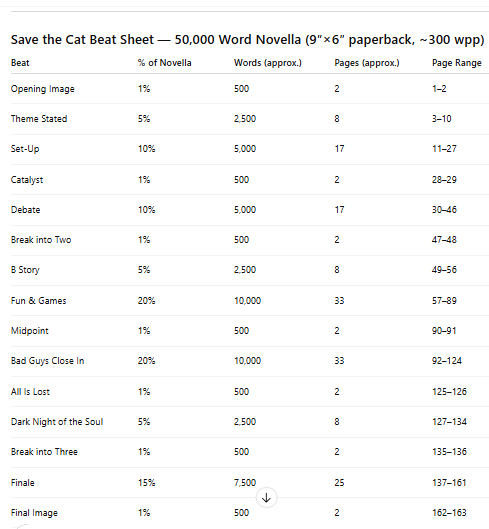
Okay, back to the topic at hand. I used ChatGPT to create the handy table below. I’m sure this has been done before, but I’ve included it here for quick reference. I’m most concerned with the Words (approx.) column for each beat. Additionally, this is for a 100,000-word novel, a nice round number, which is the word count I aim for in my books.
I plugged the first completed draft of my novel, Oblivion’s Hope, into this chart, and I discovered a few things …

What did I discover about my first draft’s word count distribution?
Here are a few of my surprises and affirmations:
- My Fun and Games beat is too long.
No surprise here. I just didn’t realize it was more than double the recommended word count for the Fun and Games part. 52,000 words! For a 100,000-word novel, the Fun and Games should be around 20,000 words. I’m going to have to do a lot of merging, splicing, and reducing of scenes. - My Finale is too short.
For a 100,000-word novel, the Finale beat should be around 15,000 words. My finale? 4,600 words. What? I’m afraid that will seem too rushed for the climax of my story. So, guess what? I’m going to be bulking up that last 15% of my draft. - My single scene beats were on point.
Some beats are only one scene, and for each of them, I nailed the right word amount. For a 100,000-word novel, the word requirement is 1,000 words each – and that’s where I landed for each one of them. I was pleasantly surprised.
What if your word count isn’t 100,000?
Here is the prompt I used in ChatGPT. In ChatGPT (or whatever AI tool you use), add the number of words in your document and create your own table.
Prompt:
“Using the percentages of each beat in the Save the Cat Writes a Novel method, tell me the estimated number of words for each beat if the novel were (# of words in manuscript). Also, using a 9 inch by 6 inch template of a paperback novel, estimate how many pages each beat would be for the same manuscript length.”
If your first draft is around fifty thousand words – ideal for novellas or young adult novels – here’s the version of that breakdown for download.
How can this chart help me if I’ve already written my first draft?
Whether you used the Save the Cat beats to write your draft, you can estimate where each of them begins and ends. Here is a summary of each beat by Brody herself. In whatever software you are using, highlight the words in that beat and get the word count. See how it measures up against the table above (if your manuscript is around 100,000 words), or against a table you created.
How can this chart help me if I haven’t already started my first draft?
With caveats, I suggest writing a rough draft or first draft of a novel using the table word and page counts for each beat. I haven’t written a rough draft this way before, so I’m just imagining this. Start small, meaning write short scenes and build them up until you have the maximum word count for each beat.
What is the advantage of doing this? Ideally, the first draft should be completed with each beat about the right size – less revision is necessary. For example, the Catalyst beat wouldn’t be too far back from the start. The Midpoint beat would be . . . at the midpoint.
I’m guessing here, but pantsers would hate writing a first draft this way. And I get it. Plotters would also love this idea—just a theory.
Use the story structure of your choice
Of course, if you prefer another story structure – the Hero’s Journey, the 3-Act Structure, etc. – you could create your own table and use it. Whether you are about to write your first draft or want to see how your current draft measures up in pacing, it’s always a good idea for the writer to ask themself: Will the reader enjoy my story?
Friday’s Findings
- Save the Cat Writes a Young Adult Novel
I’ve talked a lot about Save the Cat Writes a Novel. Writers of young adult novels should check out Jessica Brody’s other book on the same 15 beats. - Fictionary
This is online subscription software that does everything I’ve talked about in this blog post. You can plug in your existing manuscript, or you can compose your novel to see if you are hitting all the beats correctly. The beats are very similar to the Save the Cat steps, so there is an easy transition. Fictionary also has many more features and resources, such as helps for writing scenes as you write them. It’s different from Scrivener in that it actively shows you how to structure your novel (Both Scrivener and Fictionary are great, but they do different things). I let my Fictionary subscription expire, but now that I am in the revision stage for some of my novels, I believe it would be an excellent tool for fixing up my manuscripts.

 Andrew M. Friday
Leave a comment