
Let’s not talk about how long ago I graduated from university. The world is a different place. I studied journalism and then went to art school. I’m embarrassed to say it took me longer than it should to realize this: graduating from high school or college is just the beginning.
School’s purpose is to teach us how to teach ourselves — or it should be. It’s not about memorizing useless facts. It should be a training center for learning how to think for ourselves. Why? Because knowledge changes. Science changes. Religion changes. History changes.
As a graphic designer, I learned how to use Photoshop, Illustrator, InDesign and the whole Adobe gang decades ago, but those software have changed over time. And I had to keep learning how to use them.
The same can be said for any subject.
My real education goes far beyond classrooms and tests — it’s a lifelong pursuit. With the vast resources available online today, anyone can continue to expand their knowledge on any subject, at any time.
I have had a few long satisfying careers over my life. I’m in that point in my life where I love to learn for the sake of learning. No interest in a degree. No certifications. Just learning. And, wow, I can do that so easily with the digital advantages we have today.
So, I decided, just for fun to become autodidactic. In my spare time, I wanted to brush up on certain subjects and discover new areas of knowledge. And I didn’t want to go take courses at a local college. And I didn’t want to take online courses. Not that there’s anything wrong with either of those. I decided to just create my own curriculum and study casually as I lived my life.
Here are the steps I took:
Pick a Subject and Create a Syllabus with AI.
I decided to study art history. Or rather, brush up on it. A few years ago, I took a wonderful video course from my city’s library website, but I wanted to revisit the subject. Art history also offers itself as an easy example for this article.
After asking ChatGPT to create a syllabus for a 14-week course (or how ever many weeks you want) on art history, I was on my way. In seconds, it created an outline for me to follow to learn art history. It reminded me handouts I would have gotten many years ago on the first day of class.
All I did was plug in the following instructions: “syllabus for introduction to art history course.” I did this for several subject I am curious about like communication theory and American literature, but I decided to go forward with art history for now.
Study ahead for each week’s subject.
This can be done in several ways. I Googled the information which happened to be early Christian art — yes, there is the art for ancient civilizations, but I felt that is too broad of a subject and deserved its own course. So, I started with Christian artwork and got the basics with a simple online search.
For each bullet point under early Christian art — things like large-scale mosaics, iconographic portraits, and architectural structures — I sought out websites with specific details and examples, and I added these to my personal notes.
Because I was studying art history, I also included graphics of paintings, sculptures and architecture from each art period. Whatever subject you pick will determine the nature of the information and graphics you collect.
Note: the autodidactic can go at his or her own pace. I usually studied one or two topics a week, depending upon how busy I was. I may study both the Dada art period and the Cubism art period in one week. Or I would skip a week in my course.
Watch YouTube videos for each subject.
After studying ahead, I would search YouTube on the specific topic of the week. It’s like having a professor give you lectures on the subject which was true for many videos. I’d create a playlist for that topic — in this case, an art history playlist — and dump everything into it. I would usually pick at least two short videos for that week’s “lecture.” I did this to get a variety of viewpoints on the same subject. I also pick videos that are no longer than twenty minutes. I can get the gist in a short amount of time. This week, I added two videos on the New Objectivity art period to my Art History playlist.
Create flashcards for each week.
This is the part where I study my notes from the videos and websites from which I’ve mined them. Traditional 3×5 cards work, but I use digital flashcards. Flashcardmachine.com is great. I ask questions based on my notes and just copy and paste the answers on the back of the digital cards. Very quick and easy.
In this first round of creating flashcards, I don’t study them too closely. My goal is to get an overall idea of the topic. While I may know what post-impressionism art is, I don’t worry too much about studying as hard as I would if I were in an actual class. Paying tuition. Taking tests. No, this is for fun, and I can come back later and review.
Go into the field.
Hands-on learning is the most effective. Videos, flashcards and taking notes are great, but they’re just laying the foundation. If possible — if the topic you study allows for it — find a way to ‘go into the field.”
For my art history course, I go to my city’s art museum and find examples of the art periods I studied that past week. Last Saturday, I found a great example of Futurism art in one gallery. I took a photo of it and added it to my notes. I’ve discovered I more frequently recognize the art period of an artwork. Sometimes, I’ve looked at a painting many times before, but I’ll do a double take and realize something like, “Oh, that’s from the Neo-Classicism period.” It’s so fulfilling to know my autodidactic endeavors are paying off in my appreciation of art.
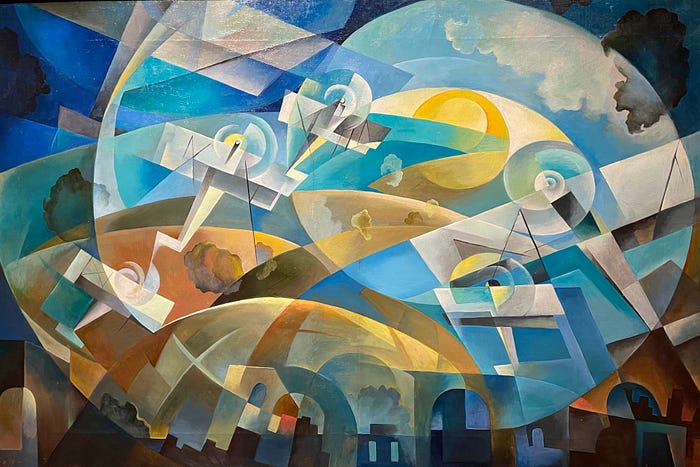
You may want to find experts in the field you study. Find teachers, businesspeople, and other autodidactics to talk with. Go visit places — like I did the art museum — to see examples in real life. Use your ingenuity to get hands-on experience.
Test yourself on your knowledge
So, I mentioned the flashcards. Once I’m done with the course I created, I’ll use them to review my knowledge of art history. I could also generate an exam on ChatGPT, but I’m not sure. I love taking tests, but I’m going to make this part optional. Since I’m doing this for the love of learning, I will test myself only if I feel like it. I’ll probably revisit certain lessons over time and add new videos to my playlist or re-read my notes. I’m going to go at my own pace. Because I can.
“I wish I had this technology when I was in university.” I know I sound like an old man when I say that — which I am to some people — but it’s true. If I could have looked ahead to see how information would be available at one’s fingertips, I would have called it science fiction. Now, it’s science fact. And it makes learning for the sake of learning so much easier.
Gosh, I wish I had a computer and the internet when I was in college. I would have killed it.
Photo by Buro Millennial

 Andrew M. Friday
Leave a comment